
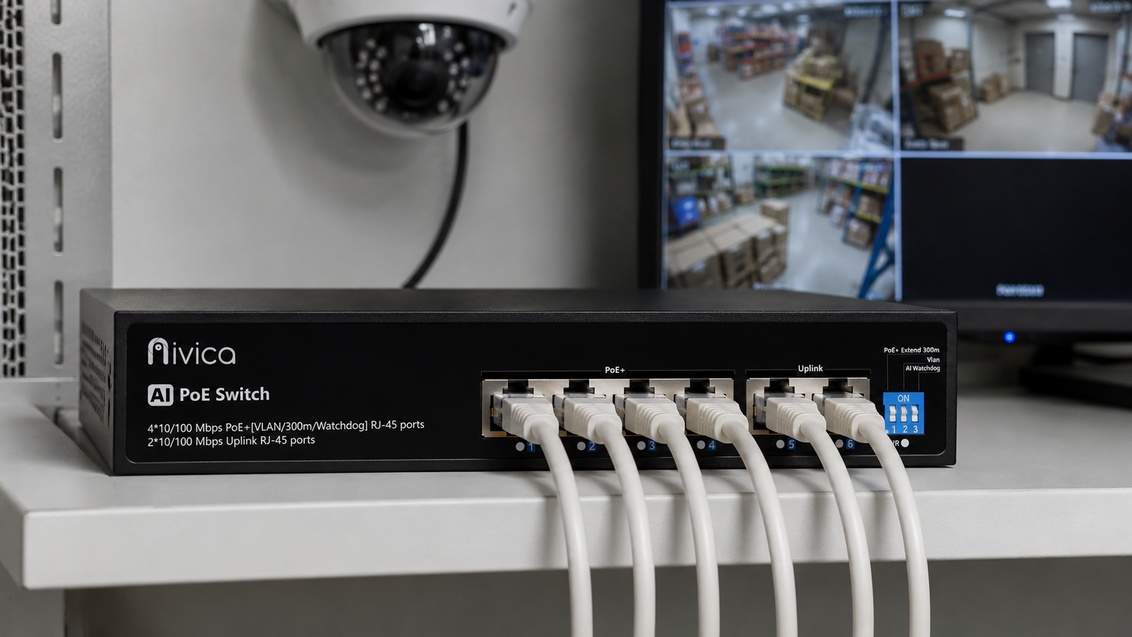
In large CCTV deployments, the real challenge is not simply connecting cameras but keeping transmission stable and power delivery predictable across the entire cable route. In practice, the installer has to account for cable length, camera power draw after IR activation, resistance to device lockups, and the ability to diagnose faults without sending a technician on site. That is why surveillance networks work best with PoE switches designed for CCTV rather than generic office hardware.
Where the 100-meter standard ends and the real field design begins
On parking lots, storage yards, long façades, and warehouse aisles, the standard 100-meter Ethernet limit is often not enough. In those situations, switches with Extend mode make sense because they can deliver PoE and data over copper up to 300 meters while limiting the port speed to 10 Mb/s. For a single IP camera, that is usually sufficient when bitrate, codec, and resolution are selected properly. In practice, the
NV-SW-0604P-XWD-2FU
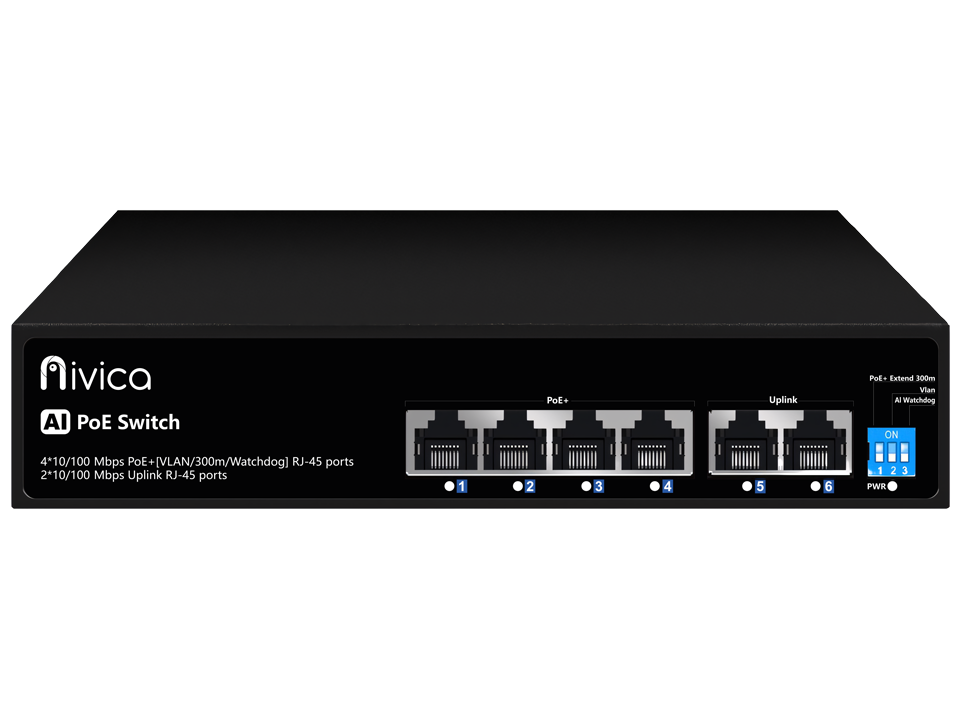 NV-SW-0604P-XWD-2FU
Unmanaged PoE Switch with Extend Mode (4x PoE 100M + 2x Uplink 100M)
works well as a simple access switch for remote cameras, while the
NV-SW-1008P-XE-2GU
NV-SW-0604P-XWD-2FU
Unmanaged PoE Switch with Extend Mode (4x PoE 100M + 2x Uplink 100M)
works well as a simple access switch for remote cameras, while the
NV-SW-1008P-XE-2GU
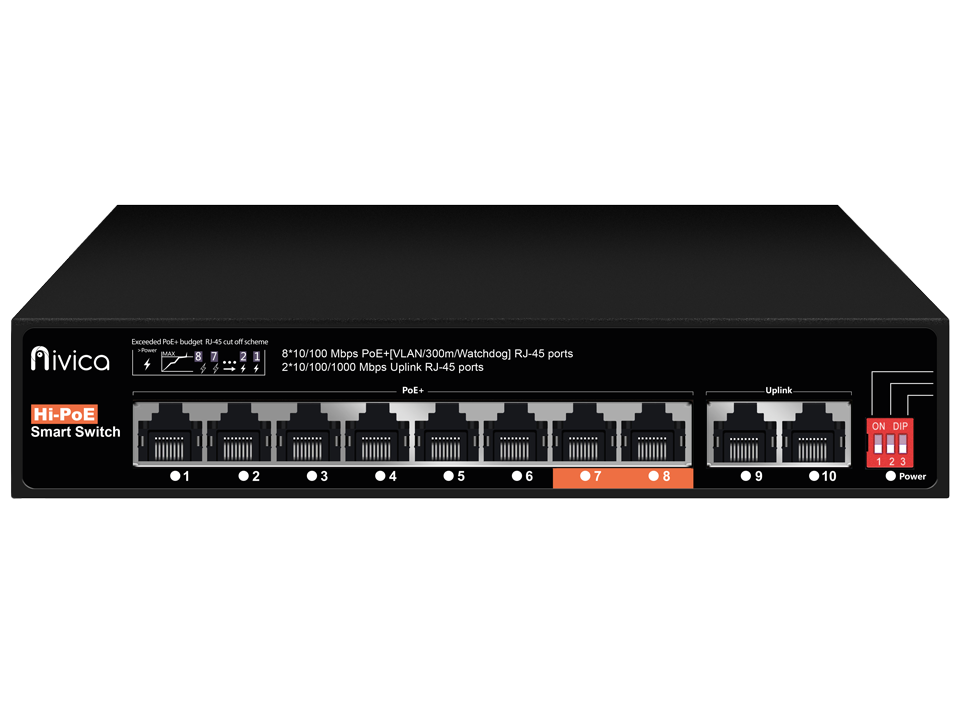 NV-SW-1008P-XE-2GU
Unmanaged PoE Switch (6x PoE 100M + 2x High-PoE 60W + 2x Uplink Gigabit)
and
NV-SW-1916P-XE-2GU1SU
NV-SW-1008P-XE-2GU
Unmanaged PoE Switch (6x PoE 100M + 2x High-PoE 60W + 2x Uplink Gigabit)
and
NV-SW-1916P-XE-2GU1SU
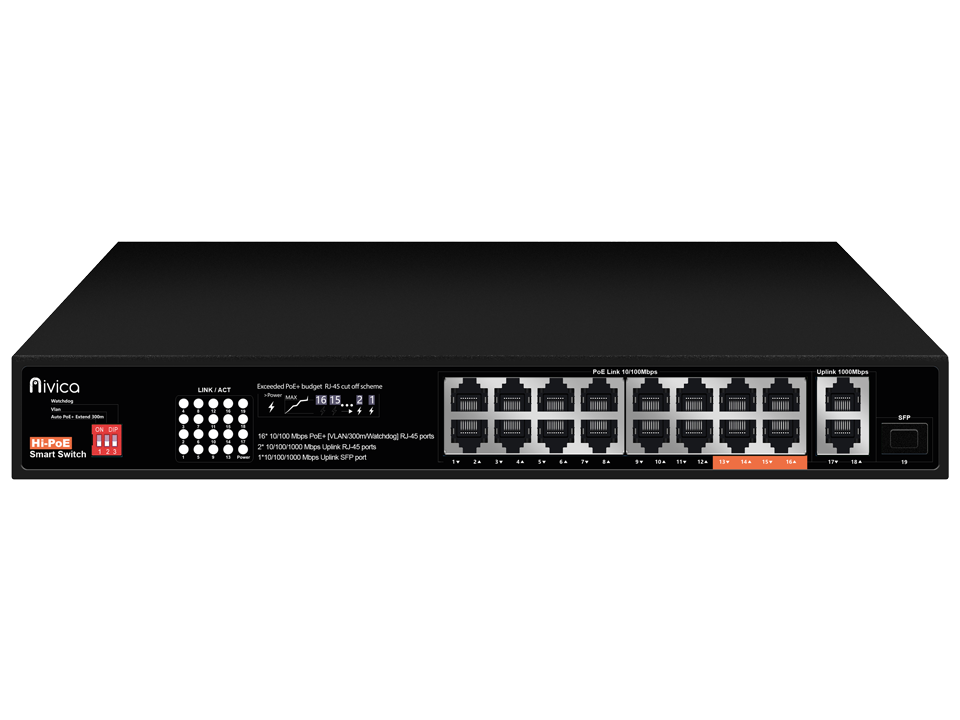 NV-SW-1916P-XE-2GU1SU
Unmanaged PoE Switch (12x PoE 100M + 4x High-PoE 60W + 2x Uplink Gigabit + 1x SFP Gigabit)
are better suited to larger port counts and uplinks toward the rest of the network.
NV-SW-1916P-XE-2GU1SU
Unmanaged PoE Switch (12x PoE 100M + 4x High-PoE 60W + 2x Uplink Gigabit + 1x SFP Gigabit)
are better suited to larger port counts and uplinks toward the rest of the network.
Watchdog, port isolation, and fewer unnecessary service visits
In surveillance systems, failure of one camera can mean losing visibility of a critical area, so features that shorten reaction time matter. AI Watchdog can automatically restart a PoE port when the endpoint stops responding, which often restores the camera without physical intervention. Hardware port isolation and VLAN mode help contain misconfiguration or broadcast storms and make troubleshooting easier when many devices share the same infrastructure. This is especially important where camera traffic coexists with other systems but still has to remain predictable.
When to move to gigabit uplinks or fiber
If several multi-megapixel cameras converge at one point or traffic must be forwarded toward the NVR and operator station, the design has to consider uplinks as well as PoE ports. Switches with Gigabit uplinks or SFP ports help prevent congestion during traffic aggregation and make it easier to separate the access layer from the distribution layer. In practice, a small field segment can be built on the
NV-SW-0604P-XWD-2FU
NV-SW-0604P-XWD-2FU
Unmanaged PoE Switch with Extend Mode (4x PoE 100M + 2x Uplink 100M)
, but once camera density grows, models such as the
NV-SW-1008P-XE-2GU
NV-SW-1008P-XE-2GU
Unmanaged PoE Switch (6x PoE 100M + 2x High-PoE 60W + 2x Uplink Gigabit)
or
NV-SW-1916P-XE-2GU1SU
NV-SW-1916P-XE-2GU1SU
Unmanaged PoE Switch (12x PoE 100M + 4x High-PoE 60W + 2x Uplink Gigabit + 1x SFP Gigabit)
become a more appropriate foundation for a scalable CCTV topology.